
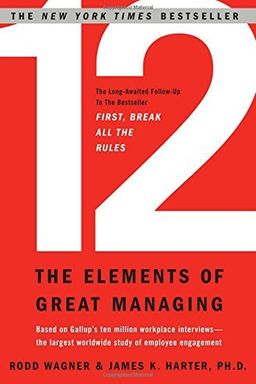
12 cover

12

by Rodd Wagner & James K Harter, PhD

Explore the science behind employee happiness and its impact on business success with ''12: The Elements of Great Managing.'' Based on extensive Gallup research, this book reveals key strategies for enhancing employee engagement, satisfaction, and performance, essential for any manager aiming to cultivate a thriving and innovative workplace.

The 12 Elements of Great Managing: The Science of Engagement

What would it take for every person you manage—or work beside—to truly care about what they do each day? In 12 Elements of Great Managing, Rodd Wagner and James K. Harter argue that extraordinary management is not born out of charisma or gut instinct but from understanding the measurable science of human engagement. Drawing on Gallup’s vast database of over 10 million employee interviews, the authors reveal that great managers transform workplaces not by imposing authority, but by fulfilling 12 universal psychological needs people have at work.

The authors contend that engagement is the most powerful predictor of organizational success—more potent than pay, perks, or leadership rhetoric. When employees feel seen, heard, and valued, productivity and profitability soar. But when these needs go ignored, companies lose billions through turnover, absenteeism, and customer dissatisfaction. Wagner and Harter show, through vivid real-world stories and neuroscience, why treating employees as human beings is both morally right and economically essential.

The Gallup Discovery

The heart of the book is Gallup’s landmark research identifying twelve statements—or elements—that define what makes a great workplace. These range from basic requirements like knowing what’s expected (“I know what is expected of me at work”) to deeper psychological and social needs (“At work, my opinions seem to count,” and “I have a best friend at work”). Each statement serves as a building block for engagement, and together they form a roadmap toward world-class management.

The discovery began when Gallup scientists analyzed over a million employee interviews, correlating their responses with hard business outcomes: productivity, customer satisfaction, safety, profitability, and turnover. They found twelve specific items consistently linked with high-performing teams. These weren’t abstract theories—they were actionable truths about human nature. The 12 Elements became the foundation of Gallup’s Q12 survey, now used globally to predict performance and guide leadership training.

Human Nature in the Workplace

Wagner and Harter insist that great managing starts with recognizing that workplaces are human systems. Our motivation, loyalty, and creativity stem from primal social instincts. People want clarity (“knowing what’s expected”), safety (“having materials and equipment to do the work right”), growth (“someone encourages my development”), and connection (“someone cares about me as a person”). The book illustrates that these drives are not modern inventions—they are evolutionary adaptations from when humans thrived in small, cooperative tribes. Modern managers ignore them at their peril.

Neuroscience backs this idea. Studies on engagement show how recognition floods the brain with dopamine—the neurotransmitter of joy and motivation—while neglect triggers stress hormones. The authors cite experiments showing how human brains mimic the actions of others through mirror neurons, explaining why role models and mentors are so influential. The biology of empathy and example makes managing deeply personal: we learn best through watching people we trust.

Why Engagement Matters

The book’s introduction, illustrated by the story of “Peanut,” a loading dock worker, sets the stage. Peanut’s loyalty and effort aren’t directed at the company’s executives—they’re directed at his manager, Lou, a leader who listens, cares, and helps his team. “Lou is the best we’ve seen,” Peanut says, “He’s made a big difference.” Through this lens, Wagner and Harter prove that engagement flows from direct human relationships, not corporate memos. The emotional bond between manager and employee drives measurable outcomes: lower absenteeism, fewer accidents, higher customer satisfaction, and increased profitability.

Top-quartile teams on Gallup’s Q12 metrics outperform bottom-quartile ones by 18% in productivity and 12% in profitability. In companies with high engagement, employees miss 27% fewer days, quit less often, and contribute more creative ideas. These aren’t soft results—they’re hard statistics showing that emotional commitment translates into tangible performance gains.

A Framework for Managers

Each chapter of 12 Elements of Great Managing brings one element to life through case studies across industries—from aircraft carriers to hospitals, from retailers to call centers. You’ll meet Nancy Sorrells, who turned around a failing Marriott hotel by clarifying expectations; Larry Walters, who reignited a demoralized Qwest call center through compassion; and Simon Gaier, who rekindled learning at a Welsh B&Q store by investing in his people. Across these examples, a pattern emerges: success depends not just on procedures, but on emotional intelligence.

Great managers are consistent in three things: they clarify goals, remove obstacles, and celebrate strengths. They act as mentors more than supervisors, coaches more than bosses. Each of the 12 Elements is a lens into one of these essential behaviors. Together, they form a business case for kindness and science—a structured path to better leadership built not on authority, but understanding.

Why This Book Still Matters

Two decades after Gallup’s first publication of these findings, the message of 12 Elements of Great Managing is timeless: what engages humans never changes. Whether you lead a team of five or five thousand, this book challenges you to see management not as manipulation but as stewardship. Profits come as a byproduct of human well-being. When you meet people’s intrinsic needs—clear expectations, resources, development, recognition, and belonging—you unlock not just their potential, but your organization’s future.

The central truth: people don’t work for companies; they work for people who care about them. Understanding and acting on these 12 elements is how great managing happens—one person, one conversation, one moment at a time.


Clarity: Knowing What's Expected

The first step toward engagement is clarity. The simplest of all the elements—“I know what is expected of me at work”—turns out to be one of the most powerful predictors of performance. Yet, as Wagner and Harter note, half of employees worldwide still say they don’t clearly know what their manager expects. It’s not a failure of motivation; it’s a failure of communication.

The Jazz Band of Work

A great team, the authors write, functions like a jazz ensemble—each player listening and adjusting to others in real time. When expectations are clear, people know how their roles harmonize within the larger performance. Nancy Sorrells, a manager at a struggling Marriott near Dallas, learned this firsthand. Her hotel was underperforming despite new equipment and experienced staff. What was missing was clarity: employees didn’t understand how their tasks connected to the hotel’s financial goals.

By redefining expectations around five mission pillars—guest experience, employee experience, profitability, product quality, and company growth—Sorrells brought coherence to chaos. Within months, engagement surged and the hotel moved from the bottom to the top 10% in performance. For her team, clarity became liberation: they no longer guessed what mattered.

Human Systems of Precision

The book compares well-aligned teams to complex but reliable operations—like aircraft carriers and cardiac surgery teams—where expectations can mean life or death. The Navy’s color-coded jersey system on flight decks shows how clear roles create seamless coordination under pressure. Likewise, even expert heart surgeons perform better at hospitals where they operate most frequently, because they work with teams whose expectations are perfectly synchronized. Team chemistry, the authors observe, is not mystical—it’s born from mutual understanding.

From Chaos to Synergy

The lesson is simple but profound: being told what to do isn’t enough. True clarity comes when employees understand how their individual contribution fits into a shared goal. As Sorrells told her team, “We’re on a life raft, and when I yell ‘stroke,’ we move in the same direction.” That sense of collective rhythm—the confidence that everyone’s efforts build toward something meaningful—is the essence of great managing.

Key takeaway: Clear expectations are not commands—they are coordination. When people know precisely where they stand and how their work contributes, excellence can occur even under pressure.


Recognition and the Chemistry of Praise

The fourth element—“In the last seven days, I have received recognition or praise for doing good work”—may sound soft, but Wagner and Harter reveal that it’s a neurochemical powerhouse. Recognition triggers dopamine release in the brain, the same pleasure chemical associated with achievement and motivation. Regular, authentic appreciation rewires the workplace from tension to joy.

Why Praise Matters

The authors cite studies in neuroscience showing that a compliment can spark the same neural satisfaction as monetary reward. Teams with high praise ratios outperform their peers by up to 20%. Conversely, employees who feel unseen are twice as likely to quit within a year. Leaders who skip recognition aren’t being efficient—they’re being expensive.

Consider Elżbieta Górska-Kołodziejczyk, who inherited a disorganized warehouse team at International Paper’s Kwidzyn plant in Poland. Early attempts to praise her workers backfired—men resented public acknowledgement and accused her of favoritism. Undeterred, she switched to private, individual recognition: quiet thanks, handwritten notes, and small kindnesses like flowers on birthdays. Slowly, cynicism turned into commitment. Within two years, her team’s engagement rating jumped from the lowest quartile to the top 25% in Gallup’s global database.

The 5-to-1 Ratio

Research cited in the book and echoed by psychologist John Gottman’s marital studies finds that successful teams, like successful relationships, maintain a ratio of five positive comments for every negative one. When negativity dominates—even under the guise of tough love—creativity collapses. A culture of genuine, frequent praise keeps dopamine flowing, bonding teammates emotionally and cognitively.

Praise with Purpose

Authentic praise doesn’t mean empty flattery. It’s about noticing effort, not just outcomes. When leaders say “I saw what you did today, and it made a difference,” they signal awareness and appreciation. In Górska’s case, she ended every week with team-wide gratitude notes—“Thank you everyone for making everything shine clean!” Humbled workers pinned the slip to their lockers as reminders they mattered.

Key takeaway: Praise ignites biochemical motivation. When you make appreciation part of daily life—not yearly reviews—you turn recognition from nicety into necessity.


Development Through Mentorship

The sixth element, “There is someone at work who encourages my development,” explores mentorship as the greatest multiplier of engagement. Wagner and Harter trace the idea of mentorship back to Homer’s Odyssey, where the character Mentor guided Telemachus. They argue that mentoring is not a corporate program—it’s a timeless human instinct grounded in empathy and example.

The Mirror Neuron Effect

Neuroscience reveals that we learn by imitation. The Parma study on “mirror neurons” showed that when a monkey watches someone grasp a peanut, the same neurons fire as if it performed the act itself. Humans, too, absorb behaviors by observing models—explaining why apprenticeships outperform manuals. The authors use this finding to show how real mentorship activates deep, biological learning circuits.

Pete Wamsteeker’s Example

When Pete Wamsteeker joined Cargill as a teenager, his first boss challenged him with Socratic questions: “What are you planning?” “Why college?” “Do you know what sacrifice means?” Eventually, that mentor wrote him a tuition check to show faith in his decision. Decades later, Wamsteeker became a celebrated Cargill manager, guiding his team with the same care. He used notes after conversations to tailor coaching and told nervous new hires, “I’ll never let you get knocked out—fight, but I’m in your corner.” His team’s engagement soared into the top 10% globally.

The Cascading Effect

Mentorship multiplies. Managers who had their own mentors are more likely to mentor others, creating what Gallup calls the “cascade” of engagement—from CEO to intern. In companies without mentors, only 1% of employees achieve high engagement through other means. Two-thirds of those with mentoring relationships are fully engaged.

Key takeaway: Development can’t be institutionalized—it must be personalized. A great mentor doesn’t assign lessons; they embody them. Example, not instruction, is the true classroom of great managing.


Connection and Care

The fifth element—“My supervisor, or someone at work, seems to care about me as a person”—might be the book’s emotional centerpiece. Wagner and Harter view caring as the foundation of trust, without which every other engagement factor collapses. Human beings evolved to survive through cooperation; ignoring emotional bonds at work violates that ancient design.

Why Care Works

People perform not just for pay, but for people. Larry Walters transformed a failing Qwest call center in Idaho Falls by replacing fear with affection. When Walters arrived, employees dreaded coming to work—grievances were high, turnover rampant, and half the building’s lights were literally turned off. Walters re-lit the company by showing genuine interest in his workers’ lives. He asked about their families, celebrated birthdays, and wore goofy costumes—a milkshake, SpongeBob, even butterfly wings—just to make his team smile. Within months, customer satisfaction jumped 5%, revenue 16%, and sales productivity 68%.

The Science Behind Empathy

Neuroscientific experiments (Greene, Sommerville, and Cohen at Princeton) show that empathy and moral judgment share brain circuits. When employees feel cared for, oxytocin—sometimes called the “trust hormone”—rises, increasing openness and cooperation. Engagement, in turn, drives loyalty more than ownership or incentives ever could.

Creating Tribes

Walters understood that in modern workplaces, managers must recreate the sense of tribe our ancestors once had. Instead of decrees, he built community rituals: daily pep rallies, personalized affirmations (“You’re rock stars!”), and shared jokes. When Qwest announced expansion thanks to his turnaround, employees literally cheered and wept. Walters reminded them that caring builds trust, and trust builds results.

Key takeaway: To be cared for is to be seen. When managers invest in humanity—not hierarchy—they spark performance that policies and paychecks alone can’t buy.


Purpose and Meaning at Work

The eighth element—“The mission or purpose of my company makes me feel my job is important”—connects work to meaning. Wagner and Harter show that humans yearn not just to earn, but to belong to something that matters. When people see a direct line between their daily tasks and a greater purpose, they transcend compliance and reach commitment.

A Mission Bigger Than Profit

The authors illustrate this with the story of Cabela’s store launch in West Virginia. Faced with floods, supply shortages, and even a last-minute presidential visit, Manager Mike Boldrick’s team refused to quit because they believed in their mission: sharing the joy of the outdoors. Employees with deep passion for hunting, fishing, and nature saw the store not merely as retail—it was a playground for kindred spirits. Their sense of shared purpose fueled superhuman effort through chaos.

From Ice Cream to Calling

The authors remind us that meaning isn’t reserved for noble professions. Even ice cream makers once wrote their own “Declaration of Principles,” celebrating how their product spread happiness. Whether curing disease or selling dessert, people crave to feel that their work improves lives. As psychologist Mihaly Csikszentmihalyi observed, fulfillment arises when personal values align with a mission—what he called “a calling.”

The Emotional Bottom Line

Employees connected to purpose report 15–30% lower turnover and 10–15% higher profitability. That isn’t mysticism—it’s humanity measured in numbers. Boldrick’s team turned their belief into results, breaking company sales records and redefining the meaning of success. When people believe their work matters, even exhaustion feels like triumph.

Key takeaway: A paycheck feeds the body, but purpose feeds the spirit. When people know why they work, they’ll pursue what seems impossible.


Progress and Growth

The eleventh and twelfth elements—“Someone has talked to me about my progress” and “I have opportunities to learn and grow”—complete the cycle of engagement. Wagner and Harter show that sustained motivation demands visible progress. When people see themselves improving, they feel alive.

Continuous Feedback

Philippe Lescornez, a manager at Masterfoods Europe, epitomizes how progress conversations should work. He skips formal annual reviews in favor of daily, informal coaching calls. His constant feedback replaces anxiety with trust. By helping employees see development not as a verdict but as a dialogue (“What would you do next time?”), he creates ownership and confidence.

Learning as Growth

The Twelfth Element unfolds through Simon Gaier at B&Q Wrexham, who saved disengaged employees by reviving their sense of progress. He helped them identify aspirations, match them to training, and move toward promotions. Gaier’s store, once stagnant, leapt into the top 1% for engagement worldwide. Employees who complained of burnout rediscovered purpose through growth. Neuroscience explains why: learning lights up the brain’s reward centers, literally energizing people to perform.

The Plateau Problem

Without growth, long-serving employees languish. The authors call this “languishing”—a state marked by flat energy and lost creativity. Managers can reverse it by setting stretch goals, inviting new challenges, and linking training to real advancement. As Dr. Seuss wrote in Oh, the Places You'll Go!, progress is what turns fear into hope.

Key takeaway: Growth is the antidote to disengagement. People don’t burn out from working hard—they burn out from standing still.


The Heart of Great Managing

In the final chapter, Wagner and Harter crystallize the book’s moral: great management is fundamentally human. Despite corporate slogans like “Our people are our greatest asset,” many organizations fail to act on that truth. The authors argue that real leadership begins with stewardship—treating people’s work lives as something sacred because they occupy most of their waking hours.

From Metrics to Meaning

Gallup’s numbers prove engagement drives profit, yet the authors insist its power comes from morality as much as mathematics. Managers who see employees not as replaceable units but as humans with dreams change lives. Peanut’s boss Lou didn’t need algorithms to know that listening created loyalty. When Qwest’s Larry Walters said, “I love these people,” his team worked with passion no policy could manufacture.

Beyond Efficiency

The book closes with a stunning paradox: the best managers achieve the most by caring least about profit first. They care foremost about people, and profit follows naturally. Engagement isn’t a technique—it’s a relationship. It requires honesty, empathy, and daily courage to prioritize humanity over spreadsheets.

Final insight: The heart of great managing beats with compassion. It’s not about control—it’s about connection. Every conversation is a chance to prove that work, done well and done humanely, can be a profound force for good.

Dig Deeper

Get personalized prompts to apply these lessons to your life and deepen your understanding.

Go Deeper

Get the Full Experience

Download Insight Books for AI-powered reflections, quizzes, and more.