
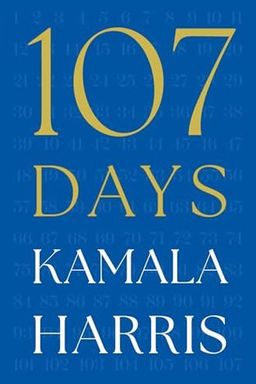
107 Days cover

107 Days

by Kamala Harris

The former vice president recounts her abbreviated campaign to become president in 2024.

Leading in the Tightest Window

How do you lead when the timeline collapses and every decision will be judged in real time? This book argues that modern American politics rewards leaders who can compress years of preparation into decisive action, tell hard truths when spin is cheaper, and defend democratic norms while running at sprint speed. Using Kamala Harris’s abrupt elevation to the top of the ticket in July and the turbulent months that follow, it makes a broader case for a leadership model grounded in speed, candor, stamina, coalition work, and constitutional duty.

What the book is really about

You see a laboratory of crisis leadership play out in public. At 1:11 p.m. on July 21, a blocked call from President Biden upends everything: he’s dropping out and endorsing Harris. Within hours, the campaign moves from ceremonial transition to operational triage—coordinated calls to Barack Obama ("Saddle up!"), the Clintons, labor, governors like Josh Shapiro and Wes Moore, and delegates who will decide the nomination. That rapid consolidation succeeds because the groundwork—relationships, data, staff—already exists. The lesson is stark: your “moment” rewards preparation you built when no one was looking.

The arc you follow

From that first day’s kitchen-table war room to election night’s boiler room, you track a candid, granular story. You watch Harris resist pressure to claim Joe Biden “won” a debate he clearly lost, choosing credibility over comfort. You sit in Wilmington as she refashions a Joe-shaped campaign without blowing it up. You go inside a compressed vice-presidential vetting that ends with Tim Walz, selected for steadiness and Midwestern reach. You enter a debate-prep crucible where performance is built through role-play, endurance drills, and unified feedback. And you toggle with her between campaign rallies and the Situation Room, brokering prisoner returns from Russia while negotiating the moral and strategic demands of Israel–Gaza, Ukraine, and Iran.

The methods that make it work

Three methods recur. First, decisive sequencing: insist on Biden’s immediate endorsement to avoid a vacuum that would invite chaos—and then synchronize public messaging with private outreach to build a fast majority. Second, truth over spin: when reality is obvious (a bad debate, a staff misjudgment, a policy tradeoff), acknowledge it, reframe it to substance, and keep moving. Third, operational discipline: tailor digital strategies by platform (Gen Z–run TikTok, Instagram for Millennials, X for political junkies, Facebook for Boomers), demand unfiltered data, and protect classified work with strict protocols even when the campaign hungers for more content. These habits protect credibility and conserve energy—the two currencies you burn fastest in a national race. (Note: This echoes the high-velocity leadership playbooks in Andy Grove’s "Only the Paranoid Survive" and Gen. McChrystal’s "Team of Teams"—move fast, share truth, align action.)

The darker terrain you must cross

The story also confronts the information ecosystem that now surrounds every campaign. Elon Musk’s interventions on X—cash sweepstakes, paid door-knockers, and weather conspiracies—turn a platform owner into an unofficial campaign actor. Fox’s editing choices reframe rallies and town halls into partisan weapons. Conspiracy theories like the "Haitians eating pets" rumor cascade from online to offline harm, forcing school closures and hospital evacuations in Springfield. The book refuses to treat this as background noise; it’s the battlefield. (In this, it aligns with Tim Wu’s and Shoshana Zuboff’s critiques of platform power, but with field-level specificity.)

What this means for you

Whether you lead a campaign, company, or civic effort, you can use these patterns. Build relationship capital before you need it. Train for the day you’ll have to choose candor over comfort. Design your organization to surface unfiltered truths, then respond with clear priorities. Build coalitions by showing up in unfamiliar rooms—Win with Black Women on Zoom, Latino barbershops, union halls, tribal councils—then connect policies (childcare, apprenticeships, gun safety, tariffs) to real lives. And, when you lose, model democratic duty: concede with dignity, certify outcomes, and turn a crowd’s grief into long-term work.

The core claim

The book’s argument is simple and bracing: in an era of compressed timelines and amplified lies, effective leadership blends speed with spine. You win credibility minute by minute—and you defend democracy action by action.

By anchoring sweeping themes in specific episodes—the 1:11 p.m. phone call, the "Saddle up!" exhortation, the nine-hour VP interrogations, the Doritos-in-the-greenroom rituals, the Springfield shutdown, and the snowy walk to certify a rival—the book turns abstractions into usable patterns. You leave with a practical blueprint for leading when stakes are constitutional and time is brutal.


From Shock to Consolidation

One call resets the race. At 1:11 p.m. on July 21, President Joe Biden tells Kamala Harris he is ending his campaign and endorsing her. What follows is not ceremony but triage. Harris senses the first trap: delay. When counselor Steve Ricchetti floats spacing the announcement and the endorsement, she pushes back hard. Any gap will create a dangerous vacuum and let rivals, rumor, and cable chyron culture define the transition. She insists: do it now, together.

The call, the clock, the narrative

Timing shapes narrative. In politics, minutes matter because they anchor the frame for weeks. Harris knows the press will interpret ambiguity as instability. By forcing a same-day, same-moment endorsement, she collapses a multi-week drama into a single, comprehensible story: the sitting president passes the torch; the vice president accepts it. It’s strategic sequencing—one decision eliminates dozens of headaches.

Anchor in the storm

“You were born for a time such as this,” Reverend Dr. Amos C. Brown tells her—a reminder to ground urgency in purpose.

The kitchen-table war room

As the endorsement posts, the family lunch table becomes a command center—binders, legal pads, and a constantly refreshing phone. She calls Barack Obama, who answers with “Saddle up!” Then the Clintons, labor leaders, and swing-state governors like Josh Shapiro and Wes Moore. She speaks with more than a hundred stakeholders, a blur of outreach that has clear goals: secure public endorsements, steady donors, and reassure convention delegates. Each call is targeted risk management. You move the people who move people.

The result is immediate momentum: $81 million raised in a single day, a visual of “joyful warriors,” and a cascade of statements that telegraph consolidation. This is where years of relationship building pay off. You can phone a hundred high-value contacts only if you’ve done the work to earn their trust. (Note: This is the political version of “dig the well before you’re thirsty.”)

Synchronize the outside and inside game

The public message—stability, continuity, unity—must align with private assurances about roles, resources, and respect. Harris and her core team (Jen O’Malley Dillon, Julie Chávez Rodríguez, Brian Fallon, Sheila Nix, Kirsten Allen) calibrate language while slotting people into new responsibilities. She signals that she will adapt the existing apparatus rather than incinerate it, which both comforts staff and reassures donors. In crisis, you don’t earn confidence with adjectives; you earn it by protecting working systems and naming what will change.

Your playbook for a sudden pivot

Three moves travel well beyond politics. First, make the deciding call about sequencing—the order and timing of announcements can inoculate you against days of damaging speculation. Second, convert relationships into decisions—call the nodes in the network (former presidents, governors, labor, donors) and ask for explicit commitments. Third, ground the team emotionally—a centering message from a trusted mentor or faith leader stabilizes people through the adrenaline. (In corporate turnarounds, you see the same pattern: immediate clarity, stakeholder lock-in, and morale anchoring.)

The episode also clarifies what not to do. Don’t create “daylight” between messages. Don’t assume time is your friend—vacums attract chaos. Don’t mistake pleasantries for commitments; get the words you need said out loud, on the record. Harris’s July 21 shows how a nomination can be forged overnight if you have the numbers, the narrative, and the nerve.


Candor Beats Spin

You cannot gaslight an audience that just watched the same screen you did. After the July 27 Atlanta debate, internal talking points arrive in all caps—“JOE BIDEN WON.” Harris rejects them. She knows the public saw a faltering performance, and to deny it would torch her own credibility. Instead, she chooses a simple, durable line: acknowledge what viewers witnessed and then widen the aperture.

Why denial backfires

The instinct to spin is strong in crisis, but it often sacrifices long-term trust for a short-term sugar high. Harris and close advisers—Brian Fallon, Sheila Nix, Kirsten Allen—recognize that saying the opposite of what millions saw would make them look dishonest. So she refuses to pretend. She centers voters’ intelligence rather than insulting it. In an age of viral clips and instant memes, your first obligation is to reality.

The reframing line

“Weigh the last ninety minutes against three and a half years of performance.” With that sentence, she repositions the debate as a data point, not destiny.

A three-step communications playbook

Harris executes a disciplined, multi-outlet strategy. Step 1: Acknowledge what people saw (“He had a bad night”). Step 2: Contextualize around policy stakes—democracy, reproductive rights, economic plans. Step 3: Pivot to records and contrasts, not vibes—tariffs as a regressive tax, results from the Inflation Reduction Act, the consequences of Trump’s agenda. She repeats this frame on Anderson Cooper and across networks. On a staff whiteboard she writes a single prompt—“Feedback?”—to keep critiques sharp and useful. The result: a coherent message chorus rather than cacophony.

The loyalty-versus-contrast dilemma

Candor also has edges. On The View, asked what she would do differently from President Biden, she answered, “There is not a thing that comes to mind.” That loyalty, honorable in intent, quickly fed attack ads tying her to an unpopular incumbent. The book treats this as a classic tradeoff: honor and unity signal stability inside a party, but they can cost contrast in a general election compressed by time. Your lesson: decide in advance how you will balance respect for allies with the need to define your own lane.

Practical guidance for your crises

When something goes wrong onstage—in politics, business, or a nonprofit—don’t insult your audience’s senses. Name the miss. Then move immediately to what still matters: your plan, your record, your alternative. Maintain one message across platforms to avoid self-inflicted contradictions. And keep a small circle willing to tell you uncomfortable truths. Credibility, once lost, rarely returns before the final vote.


Rebuilding the Machine

You don’t always get to start fresh. When Harris becomes the nominee, she inherits a Biden-built apparatus—talented people, heavy TV buys, and data that sometimes arrived curated to protect morale. She chooses adaptation over demolition: “I don’t have time to build a new plane.” The book shows how you take a working structure, rewire what matters fast, and preserve momentum.

Assess and adapt—fast

By July 28 in Wilmington, the realities are plain: an ad-first strategy didn’t arrest sliding polls; voter files need sharper segmentation; roles reflect a “Joe-shaped” org. Harris keeps what works—Jen O’Malley Dillon and Julie Chávez Rodríguez in key leadership posts—and adds trusted hands to recalibrate analytics and targeting: pollster David Binder, strategist Kristin Bertolina Faust, and adviser David Plouffe. She orders immediate polling to understand not just favorables but awareness levels. You can’t persuade people who don’t know you.

Digital by audience, not by habit

The digital pivot respects platform cultures. A Gen Z–run @KamalaHQ team steers TikTok; Instagram prioritizes Millennials’ visual storytelling; X (Twitter) serves political junkies and press; Facebook reaches Boomers. The KHive, an organic base of online supporters, counters misinformation quickly and authentically. This “fit-to-platform” model resists one-size-fits-all broadcasting and treats each channel as a distinct language. (Note: It mirrors the user-centric logic in product design—build for the use case you’re actually facing.)

Demand unfiltered truth

The most serious organizational flaw Harris spots is data laundering—information softened to avoid upsetting the boss. She insists on straight talk and changes gatekeepers where needed. She elevates aides known for candor—Kirsten Allen, Sheila Nix, Brian Fallon—and creates lanes where long-term advisers can act without bureaucratic friction. Truth is an operational asset; filtered metrics are sand in the gears.

Structure without soul isn’t enough

She also builds connective tissue. A California-based digital shop taps longtime supporters. Field teams coordinate with coalition partners—Win with Black Women, unions like the Teamsters and IBEW, Latino and Puerto Rican networks, and tribal communities like Gila River. The machine learns to listen while it speaks. That mix—precision analytics with authentic outreach—turns a campaign from projection to conversation.

If you’re inheriting a system under stress, copy the sequence. Audit fast. Keep steady hands. Redirect resources to where they change minds. Tailor messages by medium. And above all, build a culture where reality arrives unvarnished. In compressed timelines, adaptation beats reinvention because it compounds what already works.


Choosing the Right Partner

Few decisions rival the vice-presidential pick for consequence and speed. Harris has sixteen days from Biden’s endorsement—and just eleven before Ohio’s ballot printing—to vet, interrogate, and choose a partner. The process is forensic and human: binders of disclosures, crisis simulations, hours-long interviews, and quiet observation of how candidates treat the people around them.

Vetting under pressure

A heavyweight team—Jen O’Malley Dillon, Sheila Nix, former Attorney General Eric Holder, and former White House Counsel Dana Remus—runs point. Candidates submit ads, financials, and sensitive personal histories. Finalists face exhaustive questioning and scenario drills that test not just policy command but stamina and temperament. The watchword is exposure: what will break under the pressure of a national race?

Operation Veep in a Jeep

Storm Horncastle quietly ferries candidates, preserving secrecy and letting the team observe human moments—how a person treats staff often predicts how they’ll treat voters and you.

The finalists and the calculus

The field narrows to three: Pennsylvania’s Josh Shapiro (polished, state asset), Arizona’s Mark Kelly (Navy veteran and astronaut with cross-party draw), and Minnesota’s Tim Walz (Midwestern authenticity, union and reproductive rights alignment). Harris prioritizes three filters: broaden the map, reinforce governing compatibility, and minimize ambition that could undercut the ticket. The final interview stage shifts from "Can you help us win?" to "Can we trust you in the foxhole and in the West Wing?"

Why Walz

Harris chooses Tim Walz. He offers plainspoken, relational politics that resonate in the Midwest; a record aligned on labor and reproductive rights; and an ego calibrated to partnership, not overshadowing. Chemistry—operational and familial—matters. The team notes how he shows up for staff, how he carries himself with steady warmth, and how he frames disagreements. That felt sense complements the spreadsheets. (Context: Pete Buttigieg would have brought intellectual edge and national profile but a different electoral and identity signal than Harris wanted.)

Hiring lessons you can use

For your urgent hires, borrow this. Define the job as partnership, not resume. Vet beyond paperwork—simulate stress. Watch micro-behaviors (staff interactions, humility under critique). Balance reach (swing-state or market access) with reliability (no drama, aligned values). And, when time is short, front-load character. Skill trains; character reveals.

The pick closes a critical loop: it projects steadiness to voters, signals seriousness to donors, and gives the team another high-capacity surrogate for the punishing final stretch. In a tight race, a good partner is both shield and force multiplier.


Crafting Live Performance

High-stakes debates aren’t speeches; they’re athletic events in policy clothing. The book takes you into a rehearsal regime that blends choreography, critique, and endurance. Karen Dunn sets structure; Philippe Reines plays the opponent (down to Trump’s tics); Rohini and others feed focused notes. The aim is simple: build habits that hold under lights, time pressure, and provocation.

Build the reps

Sessions run late to mirror live timing. A visible countdown clock forces concise answers. After each mock, the senior team steps out, synthesizes everyone’s notes into a single, prioritized critique, then reenters with one voice. That unified coaching prevents the candidate from chasing ten fixes at once. (It’s a best practice in elite performance—from aviation to surgery: one flight director, not a committee.)

Tactics for unpredictability

No script survives live TV. The famous fly on Mike Pence’s head during the 2020 VP debate exemplifies how you must decide in real time whether to engage. Harris trains to hold focus on substance rather than spectacle. In 2024, she chooses courtesy—walking to shake Trump’s hand—because it’s who she is, not a prop. She also refuses to dignify every false claim; she prioritizes the lies that matter (e.g., tariffs) and answers with economists, price mechanics, and household impact. When a knife is needed, it’s quick: “Don’t lie.” Short, true, and done.

Micro-resilience matters

Endurance is designed, not wished. Doritos in the greenroom, Storm’s tea, Doug’s pillow notes—small rituals humanize a dehumanizing format. Staffers like Opal anticipate needs; Kirsten Allen slots last-minute interviews; Ike mails a ballot at a sprint between events. These personal and logistical buffers keep the candidate’s bandwidth for what counts: clear thinking under heat.

Your playbook for public performance

If you face a boardroom showdown or a national briefing, copy this structure. Role-play the hardest opponent you’ll meet. Rehearse at the time of day you’ll perform. Use a countdown to force clarity. After each rep, compress feedback into a single directive. Decide in advance which provocations you will ignore, which you’ll swat, and which you’ll unpack with receipts. And create micro-rituals that steady you. Precision under pressure is a trained reflex, not a personality trait.


Governing While Running

Campaigns don’t pause national security. The book toggles between rope lines and the Situation Room, showing how Harris navigates classified decisions and public rallies in the same week. You learn the logistics and ethics of dual roles: protect operations, honor alliances, and still make voter-centered cases on stage.

Diplomacy in motion

On August 6, after months of quiet work with Germany, Slovenia, Turkey, Poland, and Norway, the administration secures a multi-nation exchange that returns Americans Paul Whelan and Evan Gershkovich from Russia. These are the results of long-cultivated bilateral trust, not a single phone call. They also illustrate why public theatrics rarely substitute for patient statecraft. Harris balances celebration with operational discretion.

Israel, Gaza, and moral clarity

Meeting with Prime Minister Benjamin Netanyahu on July 30 and returning to the Situation Room on August 4, she navigates the line between advocating ceasefires and humanitarian aid and reaffirming Israel’s security. Both sides critique her—proof that nuance resists applause but often produces progress. For voters and staff, this creates tension: is visibility strengthening the administration or overshadowing the president? Harris frames her role as additive—governing well builds credibility for the campaign. (Note: This echoes the "do the work, earn the message" logic you see in wartime prime ministers.)

Classified discipline

Phones off. Cameras disabled. No texting. Governance imposes rules campaigns often ignore; she honors them, even when the comms team wants more content.

Operating principles for dual hats

Three practices keep the lanes clear. First, institutional buffers: trusted deputies and tight comms protocols prevent classified bleed into campaign chatter. Second, family and victims first: personal calls to families center the human stakes beyond headlines. Third, compartmentalization: move from a Situation Room briefing to a rally without importing the adrenaline of one into the other. If you ever run a mission-critical org while courting public approval, this is the craft: respect the operational truth, then translate its relevance without breaching it.


Information Wars and Media Power

The book treats misinformation and media capture as central terrain, not background noise. You watch lies jump from online platforms to offline harm and see how platform owners, corporate incentives, and partisan outlets shape reality at scale. Campaigns now operate inside this machinery; ignoring it is strategic malpractice.

Lies with real-world costs

After the debate, the former president amplifies a false rumor that Haitian migrants were “eating pets.” In Springfield, the cascade is immediate: school closures, hospital evacuations, and threats. The episode makes a blunt point—conspiracy is not abstract. It organizes fear, then activates threats. A candidate’s communications team is suddenly also a public-safety partner, clarifying facts while law enforcement protects families.

Platforms as political actors

Elon Musk’s X interventions—$1 million sweepstakes, hiring paid door-knockers in swing states, and spreading Hurricane Helene weather conspiracies—demonstrate how a single platform owner can affect ground games, attention flows, and trust in institutions. Meanwhile, Fox shapes narratives with selective editing and aggressive framing; Bret Baier’s interview choices and Fox & Friends’ segment packaging function like campaign assets. Even legacy outlets face pressures: CBS’s $16 million settlement after a Trump lawsuit, taken during a merger push, looks to veterans like Dan Rather like “a sellout to extortion.” Corporate incentives can chill editorial spines.

Asymmetric advertising

Targeted buys—like anti-trans spots during sports broadcasts—aim to mobilize niche voter slices. Timing and placement outgun rebuttals if you don’t preposition your own buys.

Countermeasures you can use

The campaign’s response blends speed and segmentation. Use platform-native creators to rebut lies where they spread. Train surrogates drawn from authentic communities (KHive, Win with Black Women) who can speak peer-to-peer. Pre-plan rapid ad testing in battleground media markets to avoid being time-locked out of key slots. And build relationships with local outlets, whose trust with audiences often outlasts national churn. If your issue space lives online, treat platforms as regulated environments even when they aren’t legally regulated—map risks, pre-approve counters, and track spillover from screen to street.


Coalition, Identity, and Policy

Winning coalitions are not broadcast—they’re built, room by room. The book shows Harris stitching together communities with presence and policy while refusing to let identity attacks set the agenda. You see Oprah-hosted town halls, Win with Black Women’s viral organizing, Latino and Puerto Rican visits, union roundtables, and tribal consultations—all linked to concrete proposals that touch childcare, jobs, gun safety, and foreign policy.

Build with people who build people

Jotaka Eaddy’s “Win with Black Women” mobilizes 44,000 attendees on a single Zoom and raises $1.5 million—proof of how one organizer can catalyze a national effort and inspire spin-offs like “Win with Black Men.” Latino outreach runs through Univision town halls and small-business stops in Philadelphia, where stories—like a daughter grieving a noncitizen mother’s lack of Medicare—turn policy into urgency. Labor rooms (Teamsters, IBEW) get straight talk about what another Trump term would mean; even when executive boards stay neutral, locals endorse. Tribal engagement at Gila River centers climate solutions rooted in traditional knowledge. Culture spaces—All the Smoke with NBA figures, rallies with U2 and Jennifer Lopez—extend reach without faking affinity.

Define identity on your terms

When Trump sneers that Harris “happened to turn Black” and mispronounces names to delegitimize difference, she refuses the bait. No proving, no apologizing. She centers record and community: a prosecutor, attorney general, senator, vice president; a member of Alpha Kappa Alpha and the Divine Nine; a daughter of Indian and Jamaican parents grounded in civil-rights lineage. The Shirley Chisholm thread and the viral image of her niece staring up at the podium reclaim identity as shared pride, not a defense brief. (Note: This mirrors research on “counter-stereotypic” framing—define yourself through service and narrative, not rebuttal alone.)

Make policy tangible

Policy isn’t a white paper; it’s a fix tied to a face. Childcare becomes an economic plan—universal pre-K, better wages for caregivers, and tax credits that keep providers afloat so parents can work. The jobs agenda doubles apprenticeships and expands skills-based hiring by removing degree requirements for 500,000 federal roles. On tariffs, the case is specific: they’re a regressive sales tax that spikes prices and risks recession; sixteen Nobel laureates agree. The Inflation Reduction Act’s clean-energy jobs aren’t slogans; they’re paychecks in places that need them. As head of the White House Office of Gun Violence Prevention, she drives an executive order against ghost guns and machine-gun conversion devices amid a 570% seizure spike—an enforcement lever when Congress stalls. Abroad, meetings with MBZ about Gaza and Sudan and multiple sessions with Zelenskyy show policy fluency under pressure.

The synthesis is simple: show up, listen, and tie solutions to people’s lived realities. Coalition isn’t demographic arithmetic; it’s trust earned one conversation at a time.


Loss, Duty, and Renewal

The ending is not triumphalist, and that’s the point. Election night is analytics, not theater. In the boiler room, turnout in Atlanta suburbs lags; Georgia and North Carolina trend the wrong way. The team cancels a Howard University victory speech and prepares something harder: a concession that honors work, names loss, and sustains a movement.

Facing the numbers

Data—not hope—drives the call. Staff cycle through grief stages while still doing the job. Family fills the residence; kids don’t fully grasp the immensity. Storm Horncastle quietly peels “Madame President” icing off cupcakes—one intimate image that captures the surreal mix of love and loss. The speech team huddles around a central problem: how do you reconcile chants of “When we fight, we win” with the reality of defeat?

Leadership in concession

You concede to protect the republic you sought to lead. You channel pain into purpose so people keep showing up.

Guarding the republic

In the weeks that follow, Harris walks through snow to preside over the certification of the winner—her opponent. The memory of January 6 sits heavy; the oath to the Constitution guides the moment. The book widens its lens: Project 2025, billionaire election influence, and media capture are not bursts of chaos but long-term strategies to reshape institutions. Democracy survives when leaders and citizens close procedural loops even in defeat.

Carry forward, concretely

The final call is practical optimism. Invest in Gen Z’s civic muscle. Build pipelines—education, apprenticeships, small-business capital—that prove government can deliver. Tell stories like Myshay Causey’s Cornell acceptance to remind people what progress feels like. And stop saying, “I’m giving up on America.” Two-thirds may not have chosen the winner, but 100 percent own the work of self-government.

If you lead anything that matters, memorize this arc: accept reality; concede with dignity; defend the process; and convert loss into the next season of organizing. That’s how you lose like a democrat—and live to rebuild a democracy.

Dig Deeper

Get personalized prompts to apply these lessons to your life and deepen your understanding.

Go Deeper

Get the Full Experience

Download Insight Books for AI-powered reflections, quizzes, and more.