
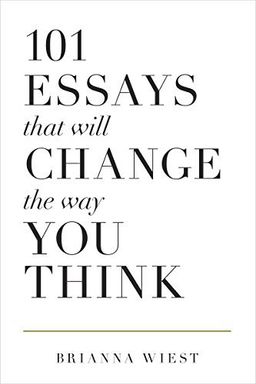
101 Essays That Will Change The Way You Think cover

101 Essays That Will Change The Way You Think

by Brianna Wiest

Brianna Wiest''s ''101 Essays That Will Change The Way You Think'' guides readers on a journey of self-discovery and growth. By managing thoughts and emotions, embracing creativity, and establishing daily routines, this book offers transformative strategies for personal fulfillment and increased happiness.

Changing the Way You Think Changes Everything

What if the way you think has been quietly shaping every corner of your life—and will continue to do so unless you learn to see, feel, and think differently? In 101 Essays That Will Change the Way You Think, Brianna Wiest argues that true transformation begins not in our circumstances, but in our thought patterns. Wiest contends that the root of our unhappiness, anxiety, and emotional confusion lies in our refusal to examine how we interpret reality. To create a life aligned with what we want, we must first learn to think consciously—because our thoughts literally build our worlds.

Wiest blends psychology, philosophy, and self-reflection to argue that changing your mind in the deepest sense is an act of evolution. Drawing from concepts like emotional intelligence, mindfulness, Stoicism (Marcus Aurelius’s power of perspective), and quantum-like “thought creates reality” thinking, she shows the connection between self-awareness and personal liberation. Each essay unfolds as a small awakening, gently exposing the subconscious ways we sabotage ourselves—through fear, avoidance, perfectionism, attachment, and the incessant need for control.

The Power of Awareness

At the heart of Wiest’s philosophy is awareness—the simple but radical act of observing your thoughts rather than being ruled by them. If humanity’s evolutionary advantage is self-consciousness, she suggests the next step is mastering it. Quoting thinkers like Yuval Noah Harari and Ryan Holiday, Wiest notes that our prefrontal cortex allows us to imagine, organize, and shape our world—but that same imagination can also enslave us. Thoughts create worlds, she writes, but only if we know we’re the thinkers. This awareness allows us to replace judgment with observation and transform pain into comprehension.

Ideas That Became Movements

The book is structured as a series of catalytic ideas—each essay revealing a blind spot we’ve mistaken for truth. For instance, the belief that “success is a place you arrive” is dismantled by explaining that life is not a checklist of milestones but a process of expansion. Similarly, the conviction that “fear means wrong” is rewritten: fear often signals you’re on the edge of what really matters. These essays encourage you to stop trying to feel “good” all the time and start interpreting your discomfort as evidence of growth and awakening.

Her central lesson is counterintuitive: suffering itself isn’t the problem—our resistance to it is. Drawn from both Buddhism and cognitive behavioral sciences, this idea reframes discomfort as the birthplace of understanding. In Wiest’s language, your worst days are often “the catalysts that break you open,” initiating the process of what she calls metanoia—a complete transformation of the mind and heart.

Thinking as a Daily Practice

The essays aren’t abstract philosophy. They challenge you to confront the subtle habits that limit your life: the way you replay old stories, the people you keep around, the beliefs you defend though they make you miserable. Wiest asks readers to turn those internal patterns into conscious choices—to practice thinking as an art form. She bridges spiritual wisdom with modern science: from Mihaly Csikszentmihalyi’s “flow” to Daniel Kahneman’s “cognitive biases,” her work positions self-awareness as emotional science, not mysticism.

Ultimately, 101 Essays That Will Change the Way You Think is about liberation—the kind that begins quietly in private reflection and ripples into every decision you make. Each essay invites you to question your programming, reexamine your habits, and redefine success, love, and happiness on your own terms. By changing your mind, Wiest insists, you change your life—not by chasing external milestones, but by mastering your inner world.


Mastering Emotional Intelligence

Brianna Wiest describes emotional intelligence as one of the most undervalued forms of wisdom in modern society. While we prize logic, speed, and achievement, few of us are taught how to navigate the internal landscape that actually drives every decision we make. Emotionally intelligent people, Wiest explains, don’t suppress feelings. They learn from them, interpret them correctly, and use their emotional responses as data—not directives.

Feeling Without Drowning

In her essay “10 Things Emotionally Intelligent People Do Not Do,” Wiest explores the ways awareness separates emotional chaos from freedom. High EQ people, she notes, do not assume emotions equal truth. Feeling abandoned doesn’t mean they are abandoned. Feeling fearful doesn’t mean danger is present. Instead, they recognize emotions as messengers: anger as a signal of boundaries crossed, sadness as grief for what mattered, fear as a sign of investment.

Like Daniel Goleman or Brené Brown, Wiest views emotions as essential teachers, not obstacles. They point us toward what needs attention. They are part of the problem-solving toolkit. When you stop running from anger and anxiety, she argues, you gain the ability to act with clarity. Suppression creates suffering; acceptance creates mastery.

Emotional Accountability

According to Wiest, real power is emotional autonomy. Emotionally intelligent people stop blaming others for their feelings. They understand that most emotional pain comes not from others’ actions but from their own resistance and interpretation. As she puts it, “Anger equals self-recognition.” When you feel triggered, you’re actually glimpsing a suppressed part of yourself. What irritates you in others is often the same trait you’ve denied in yourself.

This idea echoes Carl Jung’s concept of the “shadow self,” which Wiest frequently invokes. Growth demands integration—acknowledging rather than disowning what you find uncomfortable. By bringing awareness to these hidden patterns, you remove their control over you.

Why It Matters

Emotional intelligence doesn’t mean being unemotional; it means being a well-tuned instrument rather than one constantly out of tune. In relationships, careers, and self-discipline, it’s the determinant of stability and contentment. Wiest reminds you that emotional sophistication is what allows you to listen before reacting, to experience pain without becoming it, and to love without losing yourself.


The Psychology of Daily Routine

Wiest reframes routine not as dull repetition but as a framework for freedom. Her essay “The Psychology of Daily Routine” argues that habit shapes everything from mental health to destiny. We romanticize spontaneity, yet it’s structure that releases creativity. Our brain craves predictability; it tells the nervous system when we’re safe.

Structure as Stability

“Happiness,” writes Wiest, “is not how many things you do, but how well you do them.” Routine yields emotional regulation. When you plan your day—whether it’s waking, meditating, creating, exercising—you give your subconscious a sense of safety. Disorder, on the other hand, activates fight-or-flight. Lifelong joy isn’t built on perpetual novelty but on deliberate consistency.

This idea aligns with Mihaly Csikszentmihalyi’s research on flow: when repetition meets presence, effort becomes effortless. Wiest reminds us that routine is not the enemy of passion—it’s passion’s soil.

The Paradox of Regulation

She observes that people resist routine because they equate regulation with boredom. Yet discipline is not limitation—it’s liberation. By deciding in advance how to spend your time, you reduce decision fatigue, turning focus toward what unleashes inspiration. The goal is not rigidity but rhythm—a personal choreography of work, rest, and play that keeps life grounded.

In a distracted era, Wiest’s message feels almost radical: choose to repeat what works. Craft days that support rather than drain you. Your habits build your mood—and your mood builds your life.


Discomfort as the Path to Growth

Few authors make discomfort sound so nourishing. In essays like “Uncomfortable Feelings That Actually Indicate You’re on the Right Path,” Wiest turns pain into a compass. Many of us assume fear, sadness, or confusion mean we’re failing. She insists the opposite: discomfort often signals expansion. Growth is pain leaving your body and old beliefs leaving your mind.

Signs of Expansion

Wiest lists common “symptoms” of transformation—feeling lost, agitated, or uncertain—as proof that your life is evolving. Childhood patterns re-emerge, friends fall away, or longtime dreams crumble. It’s not regression but realignment. She likens these phases to tectonic shifts: uncomfortable but necessary to form new landscapes.

Pain as Teacher

Drawing from Stoicism (“The obstacle is the way,” Ryan Holiday) and trauma psychology, she explains that emotional pain surfaces when it’s being processed. It’s not punishment but purification. Humans evolved to grow through adversity—the mind stretches as the heart heals. Rather than “fix” unpleasant feelings, she suggests you listen to them: they reveal what must change or what you must release.

Her argument reframes resilience. You don’t cultivate resilience by numbing out but by observing pain until it reveals its message. In Wiest’s worldview, the sharpest discomforts carry the deepest truths.


How to Stop Holding Yourself Back

According to Wiest, most people are not afraid of failure—they’re afraid of living fully. In essays about self-sabotage and the “knowing–doing gap,” she exposes how we unconsciously avoid success because it threatens our comfort zones. Human brains prefer the familiarity of suffering to the risk of joy.

Breaking the Upper Limit

Borrowing from Gay Hendricks’s concept of the “Upper Limit,” Wiest argues that everyone has an internal cap on how happy or successful they allow themselves to be. When life surpasses that threshold, we self-sabotage—picking fights, procrastinating, or downplaying success—to return to emotional safety. Her advice: raise your baseline. Gradually expand your capacity to feel good.

The Knowing-Doing Gap

Another pattern that keeps people stuck is what psychologists Jeffrey Pfeffer and Robert Sutton call “the knowing–doing gap.” We know what’s good for us—sleep more, eat better, start the creative project—but we don’t act on it. Wiest’s solution is to shift focus from comfort to consequence. Don’t ask how uncomfortable it will be to try; ask how uncomfortable it will be if you don’t. Action creates clarity.

Ultimately, getting unstuck means admitting that paralysis is a choice. Every small committed act—writing one page, forgiving one resentment—proves you are free to change. Growth belongs to those who act before they feel ready.


Rethinking Love and Relationships

Throughout the book, Wiest dismantles cultural myths about love. She reminds us that relationships mirror our inner worlds: “Every relationship you have is with yourself.” We don’t fall for people—we fall for reflections. To change your love life, you must first change what you believe about yourself.

Love as Mirror

Drawing from Jungian psychology, Wiest explains that we attract partners who reveal our unhealed parts. Loving someone who cannot love you back, she says, isn’t bad luck—it’s self-education. These relationships show you the love you have yet to give yourself. Once you learn that lesson, you outgrow the pattern. “The purpose of love,” she writes, “is to see yourself completely.”

The Courage to Choose Love

Wiest also flips the myth of “self-love before love.” You don’t have to love yourself perfectly to deserve connection. Love is often what helps you learn self-love in the first place. Wholeness, she notes, is not a prerequisite for love—it is the product of it. Healthy relationships come from two aware people willing to grow, not two flawless beings with no needs.

Her message is clear: stop waiting for perfect readiness. Love is not a prize for the healed; it’s the process that heals.


Redefining Success and Simplicity

In an age obsessed with hustle, Brianna Wiest calls for radical simplicity. She sees chasing happiness and perfection as modern delusions. Quoting Alan Watts and Stoic thinkers, she argues that joy cannot be achieved through striving—it’s uncovered through awareness. Success, she writes, is not how impressive life appears, but how peaceful it feels.

The Fallacy of Arrival

Society sells us the illusion of “arrival”: that after the right job, partner, or apartment, happiness will stabilize. Wiest dismantles this belief. Life has no final destination—only continuous now-moments. “There is nowhere to arrive except the present moment,” she insists. When you stop waiting for tomorrow, you reclaim the only time that ever exists.

The Art of Enough

Wiest’s later essays, like “Simplicity” and “Let Yourself Be Happier Than You Think You Deserve,” encourage you to love what’s ordinary. Drink your morning coffee slowly. Find awe in folding laundry, in water flowing, in sunlight on your skin. She echoes the minimalist philosophy of Leo Babauta and the mindfulness of Thich Nhat Hanh: simplicity is not deprivation; it’s refinement of joy.

The truest wealth, Wiest concludes, is presence—liking what doesn’t cost much and learning to see beauty everywhere. Simplicity, then, is the ultimate sophistication.

Dig Deeper

Get personalized prompts to apply these lessons to your life and deepen your understanding.

Go Deeper

Get the Full Experience

Download Insight Books for AI-powered reflections, quizzes, and more.