
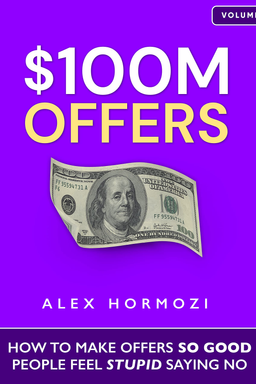
$100M Offers cover

$100M Offers

by Alex Hormozi

$100M Offers reveals the secrets to crafting irresistible products that sell themselves. Alex Hormozi breaks down the psychology of pricing and value, teaching how to differentiate and optimize offers. Transform your business with Grand Slam Offers that customers can''t refuse, boosting profits and client acquisition effortlessly.

Crafting Offers So Good People Feel Stupid Saying No

Have you ever wondered why some products make people line up overnight while others struggle to get a single buyer? In $100M Offers: How to Make Offers So Good People Feel Stupid Saying No, entrepreneur Alex Hormozi lays out a step-by-step framework for constructing business offers that practically sell themselves. His message is both simple and radical: most businesses don’t fail from lack of hard work—they fail because their offers aren’t compelling enough to attract attention and close sales.

Hormozi argues that the success of any business begins with the offer—the combination of pricing, value, guarantees, and delivery strategy that determines how customers perceive your product. Through his own rise from near-bankruptcy to building multi-million-dollar companies, Hormozi learned that he could transform struggling businesses by reimagining their offers. He calls these high-impact, transformative packages Grand Slam Offers—deals so irresistible that prospects cannot logically or emotionally refuse them.

The Stakes of Irresistibility

At the heart of the book is the sobering truth that most entrepreneurs compete in commodity markets. They fight to sell similar products and services at slightly lower prices, exhausted by the race to the bottom. Hormozi’s counter-strategy is differentiation through perceived value. When your offer clearly outmatches alternatives in results, convenience, or potential transformation, price becomes irrelevant. This philosophy, echoing thinkers like Dan Kennedy and Seth Godin, flips traditional marketing on its head: your goal isn’t to sell harder, it’s to structure smarter.

Hormozi traces his revelation back to the failures of his early gym ventures. Homeless and desperate, he learned that people wouldn't buy a gym membership for $99 a month—but they would pay thousands upfront for a guaranteed transformation if it promised speed, certainty, and minimal effort. That realization became the DNA of his future companies and this book’s core methodology.

From Commodities to Grand Slams

A Grand Slam Offer, Hormozi explains, is a combination of several powerful levers: premium pricing, massive value creation, psychological enhancements such as scarcity and urgency, risk reversal through guarantees, and clear, attention-grabbing naming. Get these right, and you not only capture a customer—you create a brand that dominates its category. The framework is designed to make your offer incomparable, shifting the customer’s decision from “which provider should I choose?” to “should I get this transformation or not?”

He sums up the central formula with what's known as the Value Equation. According to this model, value increases as you raise the dream outcome and the perceived likelihood of success, while it decreases with time delay and effort or sacrifice. Your job as a business owner is to push the upper variables higher and the lower ones closer to zero—making the outcome faster, easier, and more certain in the customer’s mind.

The Journey and the Framework

Hormozi organizes the book into five major sections that act like stages of offer transformation. In the first, he shares how desperation taught him to reframe business problems as offer problems. Then he dives into pricing psychology, revealing why charging more can actually help both you and your clients. The third section focuses on building value—layering bonuses, removing obstacles, and solving customer pains so completely that your offer feels almost unfairly stacked in their favor. Fourth, he teaches ethical persuasion tactics—scarcity, urgency, guarantees, and naming—to trigger buying decisions. Finally, he concludes with execution principles to help entrepreneurs apply these ideas to reach their first $100,000 in profit.

Each section connects theory with practical templates, from crafting “Dream Outcomes” to developing detailed “Problem-to-Solution” matrices, and culminates in assembling what he calls a Grand Slam Offer—a bundle of irresistible elements designed to dominate any market, whether you sell fitness programs, coaching packages, or software.

Why These Ideas Matter

This book isn’t just about marketing—it's about leveraging psychology, pricing, and fulfillment design to build an empire. In a world flooded with options, differentiation through sincerity and value is your most potent asset. Hormozi’s message resonates across industries: whether you’re a freelancer or a CEO, your future wealth depends not on getting more leads but on presenting offers that customers can’t ignore.

Ultimately, $100M Offers reminds us that great products don’t sell themselves, but great offers do. By mastering this skill, you can shift from chasing customers to attracting them effortlessly—and in Hormozi’s words, finally build the “fuck-you money” freedom that every entrepreneur dreams of.


Escaping The Commodity Trap

Hormozi opens his pricing section with a brutal truth: most businesses are stuck in what he calls the commodity problem. They sell something nearly identical to everyone else’s—so customers choose the lowest price. To escape this trap, you have to stop playing the same game. Instead of competing on price, you need to compete on value perception.

The Real Cost of Commoditization

A commodity, Hormozi explains, is anything people can easily compare. If they view your service as identical to another’s, they’ll default to whoever is cheaper. This dynamic creates a downward spiral that destroys profit margins and morale. Small business owners often justify it by saying “I just need more customers,” but adding more low-quality buyers only magnifies the problem. Hormozi experienced this firsthand when his gyms competed with low-end fitness clubs offering unlimited access for $29 a month. No matter how good his trainers were, prospects saw it as the same thing—so he had to change not the product, but the offer.

Creating a Category of One

The cure for commoditization is creating what Hormozi calls a category of one. A “Grand Slam Offer” makes comparison impossible by changing the rules of the game. He developed an offer for his gyms that guaranteed clients would lose twenty pounds in six weeks—or they’d get their money back. Overnight, he stopped selling workouts and started selling transformation. While competitors argued about monthly membership rates, Hormozi was selling results. That’s the lever that pulled him out of financial collapse and into a multi-million-dollar trajectory.

The Compounding Effect of Great Offers

This shift ripples through every part of your business. The better the offer, the higher your response rates, conversions, and willingness-to-pay. In one case study, Hormozi describes an ad agency that switched from a generic “lead generation retainer” to a performance-based model: “Pay only when we bring customers who show up.” That small change made them 22 times more profitable. Why? People no longer compared them to traditional agencies. They were now buying certainty of outcomes, not labor hours.

Escaping commoditization means you stop being one of many and start being the only logical choice. As Hormozi puts it: when your offer is strong enough, selling becomes unnecessary—customers convince themselves.


Finding Your Starving Crowd

Hormozi urges entrepreneurs to recognize that even the best offer will flop if it’s aimed at the wrong market. Borrowing from the classic marketing parable of the professor who asks students what advantage they’d want for a hotdog stand, the correct answer isn’t taste, price, or location—it’s a starving crowd. In other words, all value is relative to demand.

The Four Traits of a Great Market

He defines four traits that signal a viable market: 1) strong pain, 2) purchasing power, 3) easy targeting, and 4) market growth. People must need your solution urgently, have money to pay for it, be easy to find, and exist in a growing or at least stable ecosystem. Hormozi contrasts two friends: one selling newspaper ad tech (a shrinking market), and one pivoting into mask manufacturing during COVID-19 (a booming market). Same skillset, wildly different results. When the environment works against you, even brilliance fails.

Commit to the Niche

Yet most entrepreneurs sabotage themselves with what he jokingly calls the “niche-slap” syndrome—constantly changing audiences after one failed attempt. Instead, pick a normal, non-dying market and stay there long enough to test multiple offers. Every failure is one iteration closer to success. Persisting within a niche helps you build authority and allows price multipliers to kick in.

Riches Are in the Niches

Hormozi illustrates the economic power of narrowing focus through Dan Kennedy’s time-management course example: a generic $19 time-management guide becomes a $499 bestseller when reframed as “Time Management for B2B Outbound Sales Reps.” Same content, 25 times the price. Specificity raises perceived relevance and directly correlates to willingness to pay. The tighter your target, the higher your value.

For Hormozi, riches don’t just come from finding hungry markets—they come from focusing on one long enough to understand its pain points deeply and build an offer that solves them perfectly.


The Value Equation: Creating Infinite Worth

If you could quantify the value your customers perceive, Hormozi says it would look like this formula: Value = (Dream Outcome × Perceived Likelihood of Achievement) ÷ (Time Delay × Effort and Sacrifice). Your job is to amplify the top variables and reduce the bottom ones, ideally toward zero.

Raising the Top Half: Desire and Certainty

The first two components—Dream Outcome and Likelihood of Achievement—speak to what customers want and how confident they feel about getting it. You can increase Dream Outcome by focusing on core human drives: health, wealth, and relationships. But desire alone isn’t enough; people also need to believe it’s possible. Increasing perceived certainty comes through proof—testimonials, track records, or guarantees. That’s why, for example, a veteran surgeon can charge ten times more than a new graduate for the same operation: experience communicates certainty.

Minimizing the Bottom Half: Time and Effort

A product’s value diminishes as it requires more time or sacrifice. This insight explains why liposuction can command $25,000 while gym memberships struggle to justify $100 per month. The result—getting fit—is the same, but liposuction offers faster results with less work. The closer you move your offer toward instant, effortless transformation, the more valuable it becomes.

Hormozi underscores that perception is everything. In the London subway example, passenger satisfaction improved more from adding screens showing train arrival times than from spending billions speeding up trains. People value feeling shorter waits more than the literal reduction in minutes.

The Psychology Behind Value

Human beings make value judgments emotionally, then justify them logically. So he encourages entrepreneurs to layer psychological solutions on top of logical ones—reduce perceived inconvenience, increase immediacy, and make outcomes believable. Every tweak that makes a customer think “This works for people like me, now, easily” compounds the equation’s numerator and shrinks its denominator.

In practice, this equation becomes a filter: before launching anything, ask yourself how you can make success seem faster, easier, and more certain. If your answer significantly shifts those perceptions, you’re on your way to a seven-figure offer.


Step-by-Step Grand Slam Offer Creation

Building a Grand Slam Offer isn’t guesswork—it’s a five-step creative process combining empathy, innovation, and ruthless editing. Hormozi divides it into: identifying the dream outcome, listing problems, converting them into solutions, designing delivery vehicles, and trimming and stacking value.

1. Identify the Dream Outcome

Start by understanding what your clients truly want. In Hormozi’s gym business, customers didn’t care about memberships—they wanted visible transformation. He repackaged “join our gym” into “lose 20 pounds in six weeks,” instantly aligning with their dream outcome. Always sell the vacation, not the flight.

2. List All Problems

Next, brainstorm every obstacle your prospect faces before, during, and after buying your product—financial, emotional, logistical. Hormozi teaches entrepreneurs to become obsessive about friction: confusion, doubt, or inconvenience are opportunities for value creation. The longer your list, the clearer your differentiation.

3. Turn Problems Into Solutions

Once you’ve mapped the obstacles, systematically flip each into a promise. For example: “Healthy food is confusing” becomes “We’ll teach you how to shop in 10 minutes.” “I don’t know what to cook” becomes “Instant meal plan generator.” Every pain translates into a feature or bonus that lowers perceived effort or increases certainty.

4. Build Delivery Vehicles

Then design the most practical way to deliver those solutions—done-for-you, done-with-you, or do-it-yourself formats. Creativity here is key: Hormozi lists dozens of vehicles from one-on-one calls to automated templates or prebuilt calculators. The goal is to maximize value while minimizing your cost.

5. Trim and Stack

Finally, remove low-impact items and highlight the high-value ones. Bundle the rest into named assets with clear dollar values—“The Foolproof Grocery System ($1,000 value)” or “Rapid Tone-Up Blueprint ($500 value).” A well-stacked offer feels unfairly generous, and customers perceive they’re getting far more than they pay for. That’s the essence of irresistible value.

By combining these five steps, you build offers that speak directly to human desires—certainty, speed, and ease—creating the foundation for exponential growth.


Psychological Triggers: Scarcity, Urgency, Bonuses, Guarantees, Naming

Hormozi’s fourth section bridges value creation and sales psychology. Once the offer is built, it must be presented in ways that trigger natural human biases—what Robert Cialdini calls the weapons of influence. Hormozi focuses on five: scarcity, urgency, bonuses, guarantees, and naming.

Scarcity and Urgency

Scarcity limits quantity—for example, “only 25 spots available.” Urgency limits time—“doors close Friday.” Both trigger fear of missing out. Citing a charity gala with Arnold Schwarzenegger where $25,000 tickets sold out faster after supply was cut, Hormozi demonstrates how limiting availability boosts perceived value. Similarly, he teaches businesses to set “cohort caps” or weekly client limits to convert fence-sitters without false scarcity.

Bonuses Reinforce Value

Bonuses are strategically added components that magnify value perception. Instead of cutting prices, Hormozi recommends stacking relevant add-ons—checklists, scripts, or complementary services. You can even partner with allied businesses to add third-party perks, turning your offer into an ecosystem of benefits at low cost to you but high perceived worth for them.

Guarantees Eliminate Risk

The strongest guarantee removes all perceived danger from buying. Hormozi breaks them into unconditional, conditional, anti-, and performance guarantees. An unconditional refund works best for low-ticket items; conditional guarantees tie repayment to customer performance. For high-ticket offers, “service guarantees”—like promising to work for free until results are achieved—convey supreme confidence and integrity.

Naming Creates Intrigue and Longevity

Names act as the “wrapping paper” around your product. Great naming makes the familiar feel fresh: “Six-Week Lean by Halloween Challenge” sounds more exciting than “Weight-Loss Program.” Hormozi even provides a naming formula—M.A.G.I.C.—for crafting titles that blend a reason, avatar, goal, interval, and container (e.g., challenge, bootcamp, blueprint). As trends shift, you can rename the offer without changing its core, keeping your marketing fresh indefinitely.

These psychological triggers transform even strong offers into unstoppable ones. They work not by manipulation but by aligning with human nature—scarcity creates value, clarity breeds confidence, and structure births trust.


The Virtuous Cycle of Premium Pricing

One of Hormozi’s boldest claims is that raising your prices is not greedy—it’s moral. Lowering prices, he argues, hurts customers by reducing their emotional investment, reducing their perceived value, and attracting the least committed buyers. He calls this the virtuous cycle of price.

High Prices Create Commitment

When people pay more, they pay attention. Clients who pay premium rates are more engaged, achieve better results, and become better advocates. In his own business, Gym Launch, his highest-priced clients ($42,000 a year) generated the best transformations. They were financially invested in their success, which made them easier to coach and more likely to complete the process.

Higher Prices Fuel Better Service

Charging more also lets businesses reinvest in excellence—better staff, systems, and innovation. A high-margin company has oxygen for growth. Compare this with the exhaustion of discount competitors scraping to stay afloat. Dan Kennedy famously said there's no strategic advantage in being the second-cheapest option, and Hormozi echoes this with data: price wars end when everyone’s broke.

Pricing as Positioning

Psychologically, customers equate price with quality—the infamous wine study showed identical wines rated higher when labeled expensive. Similarly, premium pricing signals confidence and uniqueness. When you charge more, buyers assume you must know something others don’t. This legitimizes your brand’s authority, allowing you to “create a category of one.”

Ultimately, premium pricing turns into a flywheel: better clients fund better service, producing better outcomes, which justify even higher prices. The result isn’t just profit—it’s pride.


Execution: Reaching Your First $100,000

Hormozi closes with a personal story of hitting his first $100,000 in personal savings—the moment he felt not rich, but relieved. That milestone represents mastery of fundamentals: crafting offers, pricing correctly, and selling with integrity. It’s a number that symbolizes freedom from fear and the first real validation of entrepreneurial skill.

The Simple Steps Forward

To reach that level, he encourages readers to implement the framework immediately, starting small but refining fast. Test your offer, gather data, and improve the value equation until clients can’t rationalize saying no. Grand Slam Offers aren’t guesswork—they’re engineered through iteration.

Hormozi reminds entrepreneurs not to personalize failure. When an offer doesn’t convert, it’s not you—it’s the offer. Every failed attempt is feedback. Keep swinging until you hit your own grand slam. Unlike baseball, one perfect hit in business can secure you for life.

Mastery Over Luck

He credits his success not to luck but to understanding repeatable principles—ones that made lightning strike four times across industries from fitness to software. His message is both practical and motivational: with mastery of offers, any entrepreneur can “become the house” rather than gamble on luck. Entrepreneurs don’t need more motivation; they need better models.

Reaching your first $100,000 is less a financial target than a rite of passage. It’s proof that you’ve learned one of business’s most valuable skills: turning ideas into irresistible exchanges of value.

Dig Deeper

Get personalized prompts to apply these lessons to your life and deepen your understanding.

Go Deeper

Get the Full Experience

Download Insight Books for AI-powered reflections, quizzes, and more.