
Idea 1
Transforming How You Read and Learn
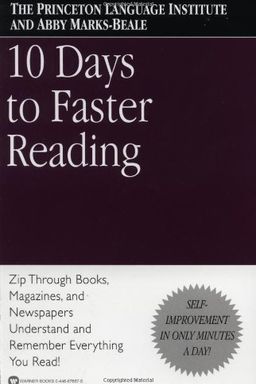
When was the last time you were taught how to read? Probably sometime in elementary school. Yet, reading is the engine that powers every aspect of adult learning, decision-making, and success. In 10 Days to Faster Reading, Abby Marks Beale and the Princeton Language Institute argue that most adults are driving their ‘reading car’ with the parking brake on—stuck in old habits designed for children learning the alphabet. The book contends that with focused practice, you can double or even triple your reading speed while actually improving comprehension and recall. And you can do it in ten days.
Beale uses a clever metaphor: learning to read faster is like learning to race cars. You already know how to drive, but racing requires precision, training, and smarter use of your mental engine. This book is your pit crew, showing you how to tune up your eyes and brain to operate at performance speed.
Why Speed Reading Matters Now More Than Ever
The modern reader faces an information overload—emails, reports, books, social media, and news. Reading faster isn’t just a luxury; it’s survival. Beale points out that most people spend hours re-reading, daydreaming, and processing inefficiently. The result? You forget most of what you read and dread starting new materials. By breaking down your ineffective habits and teaching efficient reading methods, Beale asserts that you can turn reading from a chore into a strategic skill.
She’s not promising speed for its own sake. True speed reading isn’t about racing across text and missing meaning; it’s about maximizing attention and comprehension. Think of it as reading smarter, not faster. As comprehension and concentration improve, so does your enjoyment—a key part of becoming a lifelong reader.
From Elementary Habits to Adult Mastery
Beale begins by diagnosing a universal problem: we were taught to read out loud, word-by-word, in childhood. This slow, vocalized style—what she calls subvocalization—stuck into adulthood, even though our brains can think nearly three times faster than we speak. That mismatch creates boredom, distraction, and regression (the habit of re-reading). The solution, she insists, is to unlearn the slow habits and re-train your eyes and brain to take in larger chunks of text at a time.
Speed reading is based on three pillars: expanding your visual span, reducing subvocalization, and focusing your purpose. When your eyes learn to see phrases instead of individual words—and your mind stays engaged with a clear goal—your speed naturally increases. Comprehension, surprisingly, does too, because your brain receives information at the pace it prefers to think.
The Ten-Day Training Formula
Each day of the ten-day plan introduces a new skill and practical exercise. You begin by timing your baseline speed (usually around 200–250 words per minute) and tracking it through ten days of progressive drills called Time Trials. Over ten sessions, you practice focusing, using hand or card pacers, mastering concentration, pre-viewing nonfiction material, reading keyword groupings, and managing distractions. Beale’s approach is hands-on: you measure progress, identify strengths, and experiment with techniques like the “white card method” or “Left Side Pull.” The process mirrors sports training—you build endurance, precision, and confidence.
Alongside the exercises, Beale helps you confront myths you learned in school—like “you must read every word.” She replaces those with upgraded operating principles: you must read with purpose, rhythm, and choice. Nonfiction doesn’t require memorization of every fact; it requires finding and remembering what matters. Fiction reading can remain optional—use speed for comprehension when needed, but slow down for pleasure reading.
Beyond Technique: A Philosophy of Active Reading
Speed reading, in Beale’s world, is not mechanical alone—it’s philosophical. She encourages what she calls mindful reading, an attitude shift from passivity to active engagement. Rather than letting words wash over you, you take command of purpose, pace, and attention. Active readers are selective, goal-oriented, and confident. They choose when to slow down, when to skim, and when to skip altogether. They know that comprehension only matters when connected to a real purpose—what you need to use, apply, or remember later.
By the end of the book, Beale invites you to embrace speed not as a trick but as a lifelong skill. Reading faster becomes a way to take control of your knowledge, time, and confidence. You will no longer see reading as “homework,” but as high-performance mental driving—fueling your growth instead of stalling your productivity. The race track is open. All you need to do is start your engine.